 न्यूज़व्यूज़पोस्ट
Incident overview
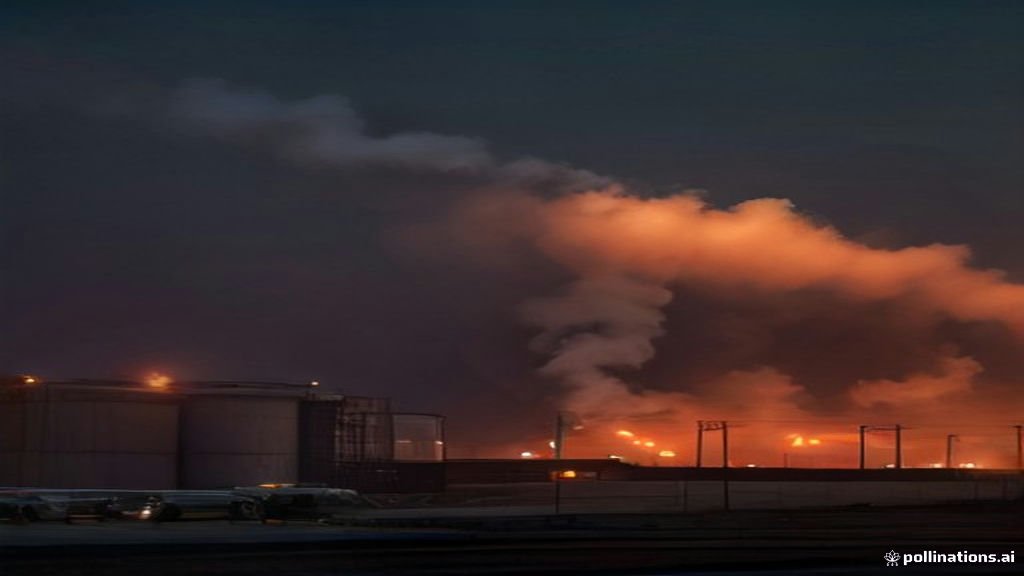
A fire triggered by an explosion at Oil India Limited’s Intermediate Tank Farm (ITF) in Tengakhat, Dibrugarh district, Assam, has claimed the lives of four workers and left three others critically injured. The blaze broke out on 6 November 2026 during maintenance activities and continued to pose a severe threat until it was brought under control. The explosion occurred while contractors were carrying out routine checks on the storage tanks, a procedure that normally requires strict isolation of pipelines and the use of intrinsically safe equipment. In this case, the sudden release of vapour ignited, leading to a rapid escalation of the fire that engulfed nearby tanks and auxiliary structures.
The fire’s intensity was such that fire‑rescue teams from the district and state had to deploy specialised foam agents and high‑capacity water pumps. The containment effort lasted several hours, during which the perimeter of the ITF was cordoned off to prevent any accidental entry by civilians. The incident highlighted the vulnerability of large‑scale petroleum storage sites to accidental ignition, especially when maintenance work is undertaken in confined spaces.
Casualties and response
All of the victims were employees of Spectron Engineering Private Limited, a Mumbai‑based contractor engaged by OIL. One worker died on the day of the incident, two more succumbed on 7 November, and a mechanical helper, Sailen Gogoi, passed away while receiving treatment on 8 November, raising the death toll to four. Three additional employees remain in intensive care, their conditions described by hospital officials as critical but stable under continuous monitoring.
Emergency services, including fire‑rescue teams and medical personnel, were dispatched promptly. The injured were transported to nearby hospitals, and the authorities have announced ex‑gratia payments of ₹10 lakh to the families of the deceased and ₹5 lakh to each injured worker. These compensation figures are in line with the statutory provisions for industrial accidents under the Employees’ State Insurance Act and reflect the government’s commitment to providing immediate financial relief to affected families.
In the aftermath, the district administration set up a temporary relief camp near the OIL compound to assist relatives of the victims. Counselors were made available to help families cope with the trauma, and the OIL management pledged to cover all medical expenses for the injured workers for the duration of their recovery.
Investigations and administrative actions
Oil India Limited has formed a high‑level inquiry to investigate the cause of the explosion and subsequent fire. The committee comprises senior officials from OIL’s safety division, external safety experts, and representatives of the Ministry of Petroleum and Natural Gas. As part of the inquiry, the four OIL staff members who were overseeing the ITF—including three officers—have been suspended pending the outcome of the probe. Their suspension is a standard procedural step intended to ensure an impartial investigation and to prevent any potential interference with evidence collection.
Union Minister Sarbananda Sonowal, who represents Dibrugarh in the Lok Sabha, and Himachal Pradesh Chief Minister Himanta Biswa Sarma have been kept informed of the situation. Sonowal contacted OIL Chairman and Managing Director Ranjit Rath to assess the emergency response, while the Chief Minister instructed his principal secretary to coordinate with OIL leadership to ensure comprehensive medical care and appropriate compensation for the affected families. Both officials have urged the inquiry to be swift and transparent, emphasizing the need for accountability and the restoration of public confidence.
The inquiry is expected to examine maintenance logs, safety checklists, and the training records of the contractor workforce. It will also review whether the required permits for hot work were obtained and whether proper isolation of fuel lines was achieved before the explosion.
Background of the facility
The Intermediate Tank Farm is a critical node in OIL’s supply chain, serving as a temporary storage hub for petroleum products before they are dispatched for further processing or transport. Such facilities handle large volumes of flammable liquids, making strict safety protocols essential during maintenance and operational activities. The ITF at Tengakhat comprises multiple steel tanks, each equipped with venting systems, over‑fill alarms, and fire‑suppression equipment designed to mitigate the risk of fire spread.
Previous incidents at similar installations have highlighted the need for robust risk‑assessment procedures, regular safety drills, and stringent oversight of contractor work. For example, a 2022 fire at a refinery in Gujarat led to a nationwide revision of the Petroleum and Natural Gas Safety Code, mandating more frequent third‑party safety audits. The current tragedy underscores gaps that may exist in adherence to these standards, prompting calls for a thorough review of safety practices across the sector.
Industry experts note that the integration of real‑time gas detection sensors and automated shut‑off valves can dramatically reduce the likelihood of such explosions. They also stress the importance of continuous competency training for both OIL staff and contracted workers, especially when dealing with high‑energy equipment.
Why this matters to local readers
The Dibrugarh region relies heavily on the oil and gas sector for employment and economic activity. The loss of four workers not only affects their families but also raises concerns about workplace safety for the many local residents employed in ancillary services such as transport, catering, and security. Moreover, a fire of this magnitude can have environmental repercussions, potentially contaminating soil and water sources if fuel leaks occur. Preliminary environmental monitoring has been ordered to test for hydrocarbon residues in the nearby Brahmaputra tributaries.
For the broader community, the incident serves as a stark reminder of the balance between industrial development and safety. Residents have expressed anxiety over possible health impacts from smoke inhalation and the long‑term ecological footprint of the fire. Local NGOs have called for greater transparency from OIL regarding the incident’s cause and for the implementation of community‑level emergency preparedness programs.
What readers should know
- Report any suspicious activity or safety violations at industrial sites to the local police (dial 112).
- Workers injured in industrial accidents can seek medical assistance through the state health department or the nearest government hospital.
- Families of victims may contact Oil India Limited’s grievance cell for information on compensation and support.
- For immediate medical emergencies, dial 108.
- Stay informed about evacuation routes and emergency assembly points designated by OIL for future incidents.
- Participate in local safety awareness workshops organized by the district administration to better understand industrial hazards.
Featured image: representational, AI generated.